

FILTER BY


Overview
While supporting the U.S. Health and Human Services (HHS) Agency, ASSYST, modernized its testing processes to overcome the limitations of traditional tools. Subtle visual and textual anomalies—like misaligned buttons, broken icons, and grammar errors—were frequently overlooked, slowing testing cycles and burdening developers. ASSYST implemented an AI-enabled solution that combined machine learning, object detection, OCR, and NLP techniques to streamline defect identification, reduce manual testing time, and enhance developer productivity. The outcome was faster testing cycles and defect-free digital services, improving the customer experience.
Challenges
The HHS Agency faced critical challenges ensuring a seamless and reliable user experience. Traditional testing tools struggled to identify subtle yet impactful visual defects, such as broken icons, alignment issues, layout inconsistencies, and unnecessary white spaces. Additionally, textual anomalies, including typographical and grammatical errors, required manual reviews that were time-consuming and error-prone. The growing scale and complexity of digital services further exacerbated these inefficiencies, slowing testing and delivery cycles. Developers spent excessive time identifying and resolving defects, delaying releases and diminishing productivity. The agency needed a precise solution to automate defect detection while accelerating the testing process.
Solution
To address these challenges, ASSYST implemented an AI-enabled defect detection solution that integrated machine learning models, OCR, and NLP. The solution was designed to automate the identification of visual and textual anomalies, ensuring faster and more accurate testing cycles.
A custom dataset of annotated UI images was created to train the Faster R-CNN ResNet-50 FPN model, leveraging transfer learning with PyTorch. This object detection model effectively identified visual defects, including broken icons, alignment problems, and white spaces across complex interfaces. To address textual inconsistencies, Tesseract OCR was integrated to extract on-screen text, which was analyzed using NLP libraries like NLTK and spaCy. This allowed the system to detect typographical errors, grammar issues, and content anomalies with exceptional accuracy.
The solution utilized OpenCV for image processing and integrated seamlessly into a .NET backend for real-time defect detection. Bounding boxes visually highlighted defects on live screens, enabling developers to identify and resolve issues quickly. The solution’s continuous learning capabilities also ensured adaptability to evolving UI designs, making it robust and scalable for future needs.
Metrics and Outcomes
The AI-enabled solution delivered significant improvements, transforming testing efficiency and accuracy:
- Manual testing time was reduced by 40%, accelerating defect identification and resolution.
- Visual defect detection achieved 95% accuracy, ensuring issues like alignment problems and broken icons were identified and addressed.
- Textual defect detection achieved 99% accuracy, efficiently resolving typographical and grammatical inconsistencies.
- Defects reaching production were reduced by 50%, ensuring a polished and seamless user experience.
These outcomes enabled faster testing cycles, improved defect resolution processes, and higher confidence in delivering error-free digital services.
Realized Benefits
ASSYST’s AI-enabled solution clearly benefited the HHS Agency’s development teams and end users. Developers could focus on innovation and core development work by automating repetitive and manual defect detection tasks. Testing processes were accelerated, boosting productivity and ensuring faster time to market for digital services. The solution’s ability to detect subtle visual anomalies and textual inconsistencies ensured a clean, professional, and error-free product.
For developers, this translated into greater efficiency and reduced frustration, leading to developer delight and improved team success. For end users, the seamless digital experience reinforced trust and satisfaction with the agency’s services.
Conclusion
While supporting the HHS project, ASSYST successfully implemented an AI-enabled defect detection solution that addressed the limitations of traditional testing tools. The solution automated defect identification reduced manual effort and accelerated testing cycles by integrating machine learning, OCR, and NLP. The result was improved developer productivity, faster defect resolution, and enhanced customer experience, positioning the HHS Agency to deliver reliable, user-centric digital services confidently.

ASSYST AI/ML Services
The ASSYST AI/ML Center of Excellence (CoE) plays a crucial role in this project. It partners with customers and their internal business and technology teams to embed AI expertise, enhancing agility and growth as AI matures. The CoE provides AI resources, strategy, and best practices, prepares AI Ready Data, embeds data scientists, machine learning experts, and product managers into project teams to work closely with domain experts. Clear communication channels ensure ongoing collaboration and knowledge sharing. The CoE evaluates AI use cases, prioritizing them based on impact, feasibility, and strategic alignment. These use cases include automating repetitive tasks, enhancing customer experiences, improving communication strategies by identifying user behavior patterns, and detecting fraud or anomalies in financial transactions.
We leverage the ASSYST Green Accelerator Program and solutions like Collab AI and ComplySyncAI to deliver accelerators that support these use cases. ASSYST focuses on data collection, preprocessing, and ensuring data quality and privacy. Model development leverages algorithms such as decision trees, support vector machines, and neural networks with precise training, validation, and performance assessment. The deployment process integrates models into production environments, leveraging a technology stack provided by Microsoft Azure, AWS, or other SaaS AI Tools. Continuous monitoring and maintenance ensure sustained accuracy, scalability, and reliability.
By incorporating and committing to human-centered design principles, we deliver intuitive, user-friendly, responsible, and humane AI solutions that meet end-users' needs.
Let’s discuss your AI Use Case.




ASSYST is pleased to announce that we are now a Cybersecurity Maturity Model Certification (CMMC) Registered Practitioner Organization (RPO). This demonstrates our commitment to enhancing cybersecurity maturity and supporting organizations in achieving rigorous federal compliance standards.
Led by Mr. Vijay Narasimhan, CTO and a certified CMMC Registered Practitioner, ASSYST provides tailored guidance to help clients navigate the complexities of CMMC compliance. Vijay’s expertise and strategic vision are central to our mission.
https://cyberab.org/Member/RPO-62569-Assyst-Inc
As we align with evolving cybersecurity frameworks, ASSYST is uniquely positioned to deliver comprehensive solutions that ensure secure, compliant operations for federal, state, and local organizations, fostering a future of security and trust across critical systems and data.

ASSYST is excited to announce our participation as a teaming partner in a winning bid for the Federal Aviation Administration (FAA) Information Technology Innovative Procurement Strategic Sourcing (ITIPSS) contract. This IDIQ multiple-award contract, with a $2.4 billion shared ceiling over ten years, will enable the FAA to acquire a full range of IT capabilities, solutions, and emerging technologies, providing state-of-the-art IT-related service solutions.
The ITIPSS contract is key for acquiring non-National Airspace System (non-NAS) IT services. It supports various functions, including FAA facilities inspections, internal and external investigations, IT resource management, financial management, and security.
Contact:
Eugene Goldlust, Sr. Account Executive
egoldluts@assyst.net | LinkedIn

In this detailed Q&A, Vijay Narasimhan, CTO at ASSYST, and John Kimberl, Health Data Analyst, discuss how AI—combined with the power of the FHIR® standard—is transforming health data interoperability. They delve into specific, highly technical use cases where AI enhances data discoverability, transformation, validation, and reporting, with each use case underscoring a step closer to achieving seamless health data ecosystems.
The 21st Century Cures Act has driven significant change by promoting interoperability, enhancing patient access to health data, and curbing information blocking practices. By mandating the adoption of FHIR®, the Act accelerates seamless data exchange across systems, improving care coordination. Moreover, focusing on empowering patients, the Cures Act opens the door for AI technologies to deliver personalized insights, predictive analytics, and dynamic care plans that enhance patient engagement and outcomes. As AI continues to innovate, the Act's provisions support the shift toward real-time, accessible, and actionable data—transforming the healthcare ecosystem.

John: Vijay, let’s dive into how AI’s technical capabilities are transforming health data interoperability, especially with FHIR® as a foundational standard. What role do you see AI playing in connecting disparate health data systems?
Vijay: AI is critical in creating adaptive, fully automated interoperability frameworks where FHIR® plays a pivotal role. With advanced machine learning models and FHIR®’s flexible data structure, we’re building platforms that harmonize diverse data formats into a universally accessible model. This is especially vital in environments like hospitals, research institutions, and public health agencies, where data must flow seamlessly between EHR systems, external labs, and other healthcare services. Using ASSYST’s Hephaestus FHIR® aPaaS, for instance, we can deploy an AI-powered interoperability solution that manages schema differences, provides real-time updates, and ensures standardized data exchange, thus delivering a holistic view of patient records.
Use Case: Enhanced Data Discoverability through AI
John: Could you talk about how AI-driven data discoverability works in a FHIR®-based ecosystem?
Vijay: Absolutely. AI revolutionizes data discoverability by using natural language processing (NLP) and entity recognition models trained on healthcare-specific terminologies like ICD-10 and SNOMED CT, seamlessly integrated with FHIR®-based resources. This enables semantic search capabilities, allowing clinicians or researchers to query vast datasets in natural language without needing deep technical knowledge of coding or terminologies.
When retrieving FHIR® resources across data sources, AI relies on FHIR® APIs, standardizing how structured health data is queried and exchanged. These APIs facilitate interoperability across disparate systems, whether within a single Health Information Network (HIN), across Health Information Exchanges (HIEs), or even between unrelated organizations, provided data-sharing agreements and permissions are in place.
AI orchestrates the process through several mechanisms:
- Federated Search Across HINs or HIEs: AI performs federated searches by querying multiple repositories simultaneously. It uses API endpoints to gather relevant resources, such as Observation or DiagnosticReport, based on specific query parameters, regardless of the data's physical location.
- Mapping and Normalization: AI ensures retrieved data adheres to a common schema, reconciling differences in terminologies or formats between sources. For example, AI maps local codes to SNOMED CT, enabling consistent and actionable insights.
- Security and Data Sharing Agreements: AI respects data governance frameworks like TEFCA, ensuring compliance with patient consent and privacy regulations such as HIPAA. It retrieves data only within the bounds of established agreements and permissions.
- Dynamic Resource Linking: AI creates contextual connections between resources. For example, when searching for “recent bloodwork with abnormal readings,” AI retrieves relevant Observation resources and dynamically links them to related Condition or Procedure resources within the FHIR® schema, simplifying the clinician's workflow.
- Caching and Real-Time Updates: AI caches frequently accessed data while querying live sources for updates to optimize performance. This hybrid approach ensures clinicians always access the most current and comprehensive information.
Use Case: Seamless Data Transformation Across Standards
John: Data transformation must be challenging, especially when healthcare data comes from various sources. How does AI handle these transformations within an FHIR® framework?
Vijay: Data transformation in healthcare is a complex task, given the range of formats like HL7, DICOM, and CDA. AI allows for adaptive mapping from these legacy formats to FHIR® resources. We use Transformer models customized for structured and unstructured data that automatically recognize and map data fields to FHIR® resources, such as mapping patient demographics from HL7 messages to FHIR® Patient resources or imaging data from DICOM to FHIR® ImagingStudy resources.
Moreover, these models improve their transformation accuracy over time using reinforcement learning. The models are trained to identify patterns and adapt mappings based on incoming data, making it possible to refine transformation processes continuously. For example, if a hospital system updates its coding practices or EHR schema, AI can detect and adapt to these changes autonomously, minimizing the need for manual intervention.

Use Case: Intelligent Data Validation to Ensure Integrity and Compliance
John: How does AI support data validation, especially given the need for strict compliance in healthcare?
Vijay: AI-driven data validation is essential for ensuring that health data remains compliant and clinically accurate. Our platform uses rule-based engines combined with ML models to validate data at multiple levels. For example, in a FHIR®-based system, AI checks if Patient resources have necessary fields filled, such as identifiers, and flags anomalies like invalid age ranges or out-of-bound values in Observation resources.
Our anomaly detection algorithms also work to ensure data integrity. By applying clustering techniques, the system can flag outliers or unexpected deviations in health metrics—for instance, identifying sudden spikes in patient vitals or dosage errors in medication data. This real-time validation helps in regulatory compliance and significantly reduces the chances of data errors affecting patient care.
Use Case: Real-Time Data Aggregation and Reporting
John: Could you describe how AI enhances real-time data aggregation and reporting within FHIR® ecosystems?
Vijay: AI’s role in real-time reporting and aggregation is transformative. By leveraging graph-based machine learning, AI can analyze relationships between FHIR® resources—such as linking Patient and Condition resources to identify population health trends. This allows healthcare providers to quickly access a consolidated view of patient data, helping them identify trends, risks, or treatment outcomes across various patient cohorts.
In practice, AI-driven tools can continuously aggregate data streams, automatically updating dashboards with the latest health data. Our AI-powered reporting system within a FHIR® environment also enables predictive analytics, such as predicting patient readmission rates based on trends in Observation and Procedure resources. The reports can be visualized dynamically, letting users drill down into metrics by diagnosis, location, or demographic data, which is invaluable for hospital administrators and public health officials.
Use Case: Automating Compliance with FHIR® and Regulatory Standards
John: Compliance is a big concern in healthcare. How does AI help ensure that FHIR®-based systems meet regulatory requirements?
Vijay: AI streamlines compliance by automating validation checks, maintaining audit trails, and proactively monitoring adherence to regulatory frameworks like HIPAA. It continuously validates FHIR® resources to ensure they meet structural and logical standards while also enforcing data-sharing policies. For instance, AI ensures that only the "minimum necessary" data is shared, as mandated by HIPAA, and flags any violations in real-time.
In addition, AI-driven anomaly detection strengthens compliance efforts by identifying irregularities in FHIR® data formats or transactions. For example, it can flag missing or unexpected fields in Patient or Observation resources or detect unusual transaction patterns, such as an unexpected spike in data requests that may indicate unauthorized access. These capabilities enable early detection of compliance risks or data integrity issues.
AI also simplifies audits by generating detailed compliance reports through natural language processing (NLP), making it easier to meet regulatory requirements. By embedding these capabilities directly into the FHIR® framework, our platform minimizes compliance risks while reducing manual oversight, ensuring data integrity and regulatory adherence across all transactions.
Use Case: Predictive Health Analytics with FHIR® Data
John: How does AI leverage FHIR® data to support predictive health analytics?
Vijay: Predictive analytics with FHIR® data relies heavily on AI to analyze historical patient data and model future health outcomes. Using time-series analysis and regression models on structured FHIR® resources, AI can predict outcomes like the likelihood of disease progression or potential readmission risks. For instance, AI models can process Condition, MedicationRequest, and Observation resources to identify patients at risk of chronic conditions, allowing for early intervention.
We’re also implementing reinforcement learning algorithms that dynamically adjust predictive models based on new data inputs, improving prediction accuracy over time. This helps healthcare providers allocate resources more effectively and implement preventive care measures based on AI-driven insights, ultimately enhancing patient outcomes.
John: It’s clear AI, combined with FHIR®, enables highly technical, transformative use cases across the healthcare spectrum. Thanks for these insights, Vijay.
Vijay: It's my pleasure, John. AI gives us the tools to enhance interoperability and optimize healthcare delivery through robust, reliable data. The integration of AI with FHIR® marks a new era in healthcare data, where seamless, compliant, and actionable insights are not just possible but are becoming the new standard.

ASSYST Health IT
ASSYST brings over three decades of expertise in delivering innovative healthcare IT solutions to federal, state, and local government agencies. As a proud HL7 Gold Member, ASSYST is deeply committed to advancing health data interoperability, leveraging industry-leading standards like FHIR® to transform healthcare delivery.
Our extensive experience spans key agencies such as the ONC/ASTP, Centers for Medicare & Medicaid Services (CMS), the Centers for Disease Control and Prevention (CDC), the Food and Drug Administration (FDA), the Health Resources and Services Administration (HRSA), and the Program Support Center (PSC). Additionally, we have supported State and Local Health and Human Services (HHS) agencies in improving healthcare systems, ensuring compliance, and driving digital transformation.

ASSYST’s Green Accelerator powered Hephaestus aPaaS (https://www.assyst.net/hephaestus/) is a powerful platform accelerating health data integration and innovation. By embedding FHIR® standards, Hephaestus supports healthcare organizations in streamlining workflows and improving data discoverability, validation, and reporting while enhancing compliance with regulatory requirements. With a clear focus on interoperability, security, and operational efficiency, ASSYST’s healthcare practice empowers clients to meet the evolving demands of the healthcare ecosystem and achieve better health outcomes through technology-driven solutions.
ASSYST, a leading IT solutions provider, is pleased to announce its selection as a Prime Contract holder under Pool 2 of the U.S. Department of Agriculture (USDA) STRATUS Basic Ordering Agreement (BOA). The STRATUS BOA, with a performance period extending through 2034, offers USDA a modern platform for accelerating cloud adoption, modernizing IT operations, and advancing mission delivery through innovative cloud integration, application modernization, and cloud security services.

Read More...
ASSYST, a leader in advanced technology solutions, has been named a Northern Virginia Technology Council (NVTC) Tech 100 honoree. This prestigious recognition highlights the top companies and individuals making transformative contributions to the region’s vibrant technology ecosystem. The NVTC Tech100 celebration event will be held on December 10, 2024, from 6 to 8 PM at the Hilton McLean Tysons Corner, Virginia.
Read More...


Recently, ASSYST’s Sr. Account Executive, Eugene Goldlust, and Business Analyst, John Kimberl, attended the 2024 Appian Government event, where they explored the latest in low-code, RPA, intelligent automation, and AI. Eugene and John closely collaborate with our delivery teams to bring innovative, best-in-class solutions to our clients, and this event provided valuable insights to enhance their work. They share key takeaways and perspectives on how emerging technology trends in low-code platforms can empower government agencies to streamline processes, boost efficiency, and enhance citizen services.
Eugene: John, I’m glad we both had the chance to attend Appian Government 2024 this year. There was so much insight into how Appian is reshaping the public sector. Where do you think we should start?
John: Absolutely, Eugene! I’d say we start with the opening keynote. Matt Calkins really set the tone, didn’t he? His emphasis on process innovation as a driver for operational efficiency was inspiring.
Eugene: I completely agree. Hearing Matt lay out how Appian’s platform is actively enabling agencies to align technology with mission objectives was powerful. It’s clear that Appian is committed to making a meaningful impact in the public sector. His point about Appian’s role across all Cabinet-level agencies really showed the trust and demand they’ve built up.
John: Yes! It really reinforced how Appian goes beyond being a product-driven company; they’re truly focused on process-based services that adapt to an agency’s needs. I think it’s this flexibility that makes Appian so valuable to public sector clients.
Eugene: Exactly, and the new tools they unveiled fit right into that mission. Ben Allen’s demo of ProcureSight was a game-changer. The way this AI-enabled procurement research tool simplifies acquisition workflows while maintaining compliance—it's going to save agencies both time and resources. Imagine the efficiencies we could apply here at ASSYST.
John: Absolutely! And did you notice how seamless Appian Case Management Studio was? That centralized tool for managing cases, integrating documents, and tracking workflows—it's a dream for anyone managing complex cases across multiple departments.
Eugene: Yes, that and Process HQ were highlights for me. Process HQ brings visibility into workflows' bottlenecks and helps make real-time adjustments. It’s exciting to think about how tools like these could elevate our work and improve stakeholder engagement.
John: Agreed, and I also noticed a big theme on process automation and AI integration. Ben McGrane from the USDA shared some valuable insights on transforming incident procurement operations. He talked about centralizing data from numerous systems, ensuring faster access to key information.

Eugene: Exactly! That project McGrane mentioned—using a process automation strategy to enhance USDA’s Forest Service procurement data management—was impressive. It’s similar to how we’re utilizing Data Lakes and Data Fabrics for our clients, but this showed a clear path for enhancing that through Appian’s ecosystem.
John: It definitely sparked ideas for our team. I liked hearing how they use AI to refine data sharing and provide teams with a holistic view. These insights fit perfectly with our work in creating interconnected, interoperable data platforms.
Eugene: Then there was the talk on low-code development. What did you think of that panel with Brigadier General Kevin Woodard and Rear Admiral William Dwyer? Their insights into Appian’s low-code capabilities for the Navy and Marine Corps’ case management systems were compelling.
John: It’s impressive to see the military adopting low-code platforms. The fact that Appian’s low-code process automation solution allowed them to deploy a secure, compliant, and user-friendly legal case management system—that’s huge! It highlighted just how agile low-code can make government services.
Eugene: The configurability is unmatched. Low-code allows agencies to customize applications without heavy coding, which means they can deploy faster and adjust as needs evolve. That approach empowers teams to solve issues directly rather than relying on developers for every small change.
John: Exactly, and this “citizen developer” concept is growing. Seeing how low-code was used to build an intuitive case management app for a city’s waste hazard management really illustrated the possibilities. The way they involved stakeholders in the design—from city officials to citizens—was a masterclass in Human-Centered Design.
Eugene: You’re right, John. This emphasis on stakeholder-driven design will be critical as we push for more user-centric applications. It was a great example of how low-code platforms like Appian’s empower end-users to customize and refine applications to their needs.
John: And then there were all the discussions on intelligent automation. Hearing the U.S. Army’s Assistant Secretary, Young Bang, discuss the Army’s 500-Day Plan for AI was impressive. They’re envisioning an AI-enabled, intelligent automation environment that could reshape decision-making processes.

Eugene: The scope of their vision was inspiring. With AI-enabled, intelligent automation, they’re aiming for more responsive and adaptive systems. It’s clear that their open-architecture approach will make it easier to adopt these innovations seamlessly across different programs.
John: Exactly. It’s a forward-thinking strategy that mirrors our approach at ASSYST, particularly as we expand our AI and automation capabilities. The idea of operationalizing AI in real-world environments was motivating.
Eugene: Lastly, I have to say, the networking opportunities were invaluable. I had some great discussions with peers and industry experts who share our commitment to improving government services.
John: Same here. I left with so many new ideas and potential partnerships that could lead to exciting collaborations for ASSYST.
Eugene: That’s the best part—Appian Government 2024 wasn’t just a showcase of tools and solutions; it was a community of like-minded professionals, all pushing for progress in government technology. Here’s to taking these insights and using them to drive meaningful changes for our clients.
John: Absolutely, Eugene. This event reinforced that we’re on the right path with our approach at ASSYST and opened our eyes to some new possibilities. Looking forward to seeing how we can apply these insights together.

ASSYST Low-Code Capabilities
What distinguishes ASSYST is our precision-engineered approach to leveraging low-code solutions tailored to complex, sector-specific needs. ASSYST’s approach ensures that each client’s unique operational and regulatory requirements are met. By fully exploiting the capabilities of low-code platforms and Cloud services, we deliver customized solutions that drive strategic objectives, optimize resource utilization, and enable rapid adaptation to evolving business landscapes.
Product names mentioned are for informational purposes only
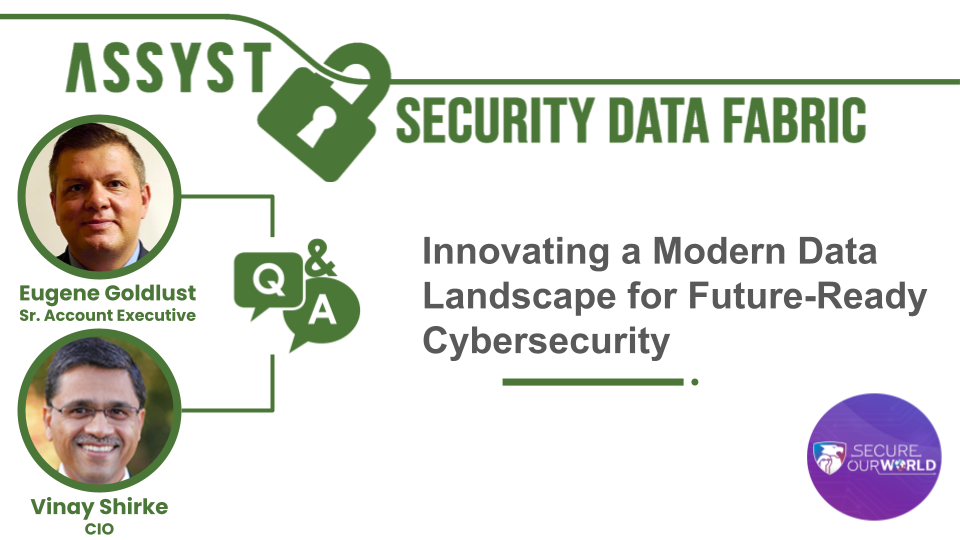
I enjoyed speaking with Vinay Shirke about ASSYST's innovative approach to a modern data landscape, Security Data Fabric. We explored how this data management framework enhances risk management, resilience, and intelligence within security data analytics. Vinay shared valuable perspectives on how ASSYST's Security Data Fabric is designed to unify and optimize security data, empowering organizations to make faster, more informed decisions to stay ahead of evolving cyber threats. This conversation sheds light on the future of cybersecurity and ASSYST's commitment to pioneering solutions for a safer, data-driven world.
Read more on LinkedIn | ASSYST' Security Data Fabric

ASSYST, as the prime contract holder for the USDA STRATUS Blanket Purchase Agreement (BOA), is excited to sponsor and exhibit at the launch event. The event, organized by the Advanced Technology Academic Research Center (ATARC), serves as a collaborative forum for the USDA, federal partners, and industry leaders to shape the future of cloud technology.
Date and Time
November 15, 2024, 7:30 AM - 3:00 PM ET
Location
USDA Headquarters Complex - Washington, DC
About USDA STRATUS
USDA designed the STRATUS Program for USDA (https://www.usda.gov/disc/stratus) to address the complexities of expiring and fragmented cloud contracts. It enables cost optimization, fosters robust competition, and leverages the government's collective buying power.
By bringing together key stakeholders, the program aims to modernize enterprise data management and streamline the procurement of leading commercial IT services and solutions for government agencies. The STRATUS initiative sets the stage for smarter, more agile cloud strategies, paving the way for a unified approach to federal cloud adoption and innovation.
Event Website
https://atarc.org/event/usda-stratus-event/
ASSYST's USDA STRATUS BOA
https://www.assyst.net/contracts/usda-stratus-boa
Scope of USDA STRATUS BOA
USDA agencies can conveniently procure a wide range of cloud integration and development services, including managed services, to meet their evolving IT needs through the STRATUS BOA. The agreement's scope covers essential areas such as governance, cloud strategy, and cloud and platform architecture, providing a solid foundation for digital transformation efforts. Agencies can also access support for cloud migration, cloud security, platform operations, and engineering, as well as CI/CD pipeline engineering, identity and access management (IAM), user management, and change management to ensure seamless cloud operations.
Additionally, STRATUS enables procurement of application development and integration, discovery, framing, and design services, fostering innovation and modernization. The BOA extends to training, operations and maintenance, sustainment, and digital product management, ensuring agencies can effectively maintain and evolve their cloud solutions. For compliance and security, USDA agencies can also leverage FedRAMP authorization, 3PAO assessor services, and security assessment and authorization (A&A), all within a streamlined procurement process. This comprehensive offering makes STRATUS a key resource for USDA's cloud modernization and strategic IT initiatives.
Meet our Team at the Launch



ASSYST Cloud Services
ASSYST’s Cloud services allow customers to build, deploy, and manage applications, services, and infrastructure in the Cloud. We utilize and administer Cloud platforms, such as Amazon Web Services (AWS), Microsoft Azure, and Google Cloud Platform (GCP), to rapidly and continuously develop and deploy applications and services for our customers’ systems and applications.
Connect with us: TeamUp@assyst.net | https://www.assyst.net/connect