

FILTER BY

The recent announcement from the Department of Defense (DoD), as shared by the CIO and as reported in the media, to accelerate software acquisition and streamline the Authority to Operate (ATO) process through the SWFT initiative is more than a policy shift. It is a signal that an exciting inflection point for government agencies, industry partners, and the broader cybersecurity community to embrace a new standard of operational speed and strategic foresight.
SWFT reimagines how software systems are assessed, authorized, and delivered across the Department of Defense. Building on earlier “Fast Track ATO” pilots, the initiative introduces a more dynamic, risk-informed framework grounded in automation, real-time telemetry, and continuous compliance. At its core, SWFT shifts the responsibility for risk determination back to the government by enabling faster, mission-aligned decisions without compromising assurance. A key part of this transformation is the enforcement of independently validated Software Bills of Materials (SBOMs), which enhance supply chain resilience and provide the foundational data needed to assess vulnerabilities and dependencies throughout the software lifecycle.
Read my take on Advancing Continuous ATO and Rapid Innovation at Scale Aligned with the DoD SWFT Vision
OnPoint Newsletter - LinkedIn


Commercial Solution Openings (CSOs) are expected to reshape federal procurement, helping both Federal Civilian and DoD stakeholders to accelerate modernization, incorporate leading-edge capabilities, and engage a wider vendor base. This change requires a delivery platform that fulfills mission critical needs, adapts to multi-domain operational demands, and upholds top security and compliance standards.
Our teams continually focus on capabilities across deployable solutions that directly meet these changing government mission requirements. The ASSYST Green Accelerator, guided by our CIO/CTO’s strategic vision, combines advanced technology, expert talent, and intelligent automation to assist agencies and partners in significantly reducing discovery time, rapidly prototyping solutions, and confidently implementing them. By leveraging this, customers have achieved measurable improvements, all while maintaining strict security and performance standards.
From Whiteboard to Mission Execution
Designed for both Civilian and DoD environments, the Green Accelerator’s modular, cloud-agnostic, microservices-based architecture integrates human-centered design with automated compliance management. Secure CI/CD pipelines are reinforced with container security, software composition analysis, SBOM verification, and real-time compliance scoring, making continuous authority-to-operate (cATO) readiness possible.

Technical Readiness Enablers
- Cloud-Agnostic Infrastructure-as-Code (IaC) – Deploy across AWS, Azure, hybrid, air-gapped, and similar environments.
- SecDevOps Toolchains – End-to-end pipelines combining SAST, DAST, IAST, dependency scanning, and automated OSCAL control mapping.
- Compliance and Interoperability by Design – Pre-certified integration patterns for NIST RMF, HL7, FHIR, and other frameworks.
Operationally Proven Solutions
- ComplySyncATO – Our AI-powered RMF compliance automation tool, integrating OSCAL, NIST 800-53 mappings, and automated POA&M tracking.
- Hephaestus – Six-component, FHIR-native healthcare data platform for ingestion, validation, mapping, exchange, analytics, and GenAI/LLM exploration.
- Agentic AI – Utilizing the Model Context Protocol (MCP) for contextual, multi modal knowledge retrieval across secure enclaves, enforcing access policies while providing role-aware, RAG enabled answers.
- Debt Management System – Microservices-based financial case management with AI-driven prioritization and real-time analytics.
- Test Automation Portal – AI-enhanced framework for intelligent test creation, execution, and reporting, enabling autonomous regression suites, real-time defect analytics, and seamless CI/CD integration.
Why It Delivers
- Accelerated Prototyping – Pre-hardened blueprints shorten MVP creation time.
- Embedded Compliance – FHIR, OSCAL, 508, SoX at every commit.
- Mission-Driven Scaling – Horizontal/vertical scaling for enterprise and tactical deployments.
- Continuous Innovation – Seamless integration with emerging frameworks and AI models.
Ahead of the Curve – Built to anticipate policy, security, and technology shifts.

Core Engineering Pillars
- Human-Centered Design (HCD) – Low/no-code, intuitive interfaces with persona driven workflows and accessibility compliance.
- Automation Everywhere – CI/CD, test automation, infrastructure provisioning, and compliance validation.
- Microservices Architecture – Loosely coupled, independently deployable services.
- Containerization – Secure container images with runtime policy enforcement.
- Deployment Flexibility – Multi-cloud, on-prem, hybrid, and classified options.
- Security-by-Design – End-to-end encryption, zero-trust networking, and NIST compliant control inheritance.
Looking Ahead
Our vision for the Green Accelerator is to continually enhance its capabilities, ensuring it remains at the forefront of Civilian and DoD/DoW Technology modernization. We plan to expand its Agentic AI features, deepen its MCP integration for multi-modal, context-aware decision-making environments, and incorporate self-healing infrastructure with real-time resilience scoring. This evolution will enable agencies to respond to mission needs instantly and proactively shape them, establishing high-assurance, rapid-deployment solutions as the operational standard.


With the US Government and federal healthcare agencies such as the Centers for Medicare & Medicaid Services (CMS) calling for a voluntary, patient-centered digital health ecosystem, the federal government is signaling a generational shift: from siloed systems and compliance checklists to platforms that deliver value through secure access, shared insight, and individual empowerment.
For ASSYST, this is not just a policy milestone—it is the continuation of a deeply held belief: that digital health systems must be human-centered, resilient, and designed for real-world outcomes.

Vinay Shirke, Chief Information Officer at ASSYST, stated:
“Technology in healthcare must move beyond transactional efficiency. It should help people feel seen, safe, and supported. This new ecosystem initiative invites us to design for dignity—not just data.”
ASSYST has long invested in this vision. As an early adopter and implementer of HL7®, FHIR®, and NCPDP standards, the company built interoperability solutions long before they became federal mandates. That commitment took shape in Hephaestus, ASSYST’s FHIR-native application Platform-as-a-Service (aPaaS), which enables real-time, standards-aligned data exchange across health systems, agencies, and applications.
Today, ASSYST supports national interoperability initiatives including the ONC Interoperability Standards Advisory (ISA), Electronic Prescribing (eRx), and Real-Time Prescription Benefit (RTPB)—making health information more accessible, meaningful, and secure for patients, providers, and programs.
But delivering wellness also means protecting what matters. As a trusted Cybersecurity Provider for CMS, ASSYST secures vital infrastructure and sensitive systems that serve tens of millions of Americans. Through solutions like the Security Data Lake, ASSYST provides real-time risk visibility, governance enforcement, and proactive protection at a national scale.
To further humanize access and reduce complexity, ASSYST is integrating Agentic AI—policy-aware digital agents that assist with secure data discovery, context-based compliance, and intelligent workflow automation. These AI capabilities are part of the company’s broader Green Accelerator initiative, which brings together cybersecurity, interoperability, and AI in a mission-aligned framework for government innovation.

Vijay Narasimhan, Chief Technology Officer at ASSYST, added:
“Wellness starts with access. But trust is what sustains it. The systems we build must not only interoperate—they must anticipate needs, adapt to policy, and center the human experience.”
ASSYST’s work spans CMS, CDC, FDA, HRSA, and several global public health programs—supporting efforts to modernize infrastructure, enable equitable data exchange, and elevate care through secure, standards-based technologies. Across it all, the mission remains the same: to support wellness, not just workflows.
“Digital health is no longer a back-office function,” said Shirke. “It’s a public service—and it must be built with the same care, empathy, and precision we ask of our caregivers.”
Vinay Shirke: https://www.assyst.net/team/vinay-v-shirke
Vijay Narasimhan: https://www.assyst.net/team/vijay-narasimhan

ASSYST CEO Shyama Mandal welcomes the release of America’s AI Action Plan, a comprehensive roadmap outlining strategic priorities for U.S. leadership in artificial intelligence. The plan’s emphasis on accelerating innovation, advancing secure AI infrastructure, and leading international collaboration aligns closely with ASSYST’s mission in federal innovation and public service.
Read On LinkedIn


In this edition of OnPoint xChange, we unpack how Agentic AI is transforming public services, not by replacing humans, but by augmenting teams with digital agents that understand mission context, policy boundaries, and how to take smart action.
I had the opportunity to interact with

John Kimberl, a Technical Healthcare Solutions Consultant supporting ASSYST’s Hephaestus FHIR platform, with a focus on health data interoperability and secure cloud solutions

Bhargav Joshi, an AI/ML Engineer leading autonomous systems engineering in ASSYST’s Green Accelerator framework

Erin Slezak, a Proposal Solution Writer, is passionate about user-centered design and accessible public services.
Together, we discussed what Agentic AI Protocols are, how Model Context Protocol (MCP) enables trustworthy agent behavior, and why metadata awareness is essential for services, interoperability, and scalable enterprise adoption.
Read More on LinkedIn

Across State and Local governments, there’s growing interest in how Artificial Intelligence (AI) might help agencies serve their communities more effectively. While budgets are tight and priorities are many, one thing is clear: people expect services to be simpler, faster, and easier to navigate—especially online.
Recently, a new type of AI capability has caught my attention—and that of many agencies I collaborate with. It’s called Agentic AI.
Agentic AI refers to intelligent software agents that not only answer questions but also take action, following rules, completing tasks, and collaborating with users and systems. The concept may sound technical, but the benefits are practical and impactful, whether that’s a resident renewing a permit or a staff member managing paperwork behind the scenes.
People Are Changing How They Access Information
Residents are no longer satisfied with clicking through multiple web pages, hoping to find the right form or process. Increasingly, they want to ask a question and receive an answer, just like they do with search engines or voice assistants.
And there’s a real opportunity here.
Instead of asking:
“Where’s the form for starting a home business?”
Imagine asking:
“How do I register a home bakery, and what permits do I need?”
“How do I apply for housing assistance?”
“What steps do I need to take to renew my driver’s license?”
And then receiving a clear, step-by-step response tailored to your location, eligibility, and agency rules.
That’s the potential of Agentic AI at the front door of government.
What Middle Offices Should Be Thinking About
Behind that front door is where most of the real work happens—document reviews, eligibility checks, multi-step workflows, and communication across systems and departments.
Agentic AI can support middle offices by:
- Coordinating task flow across teams or departments
- Interpreting policies into actionable decision logic
- Helping staff manage caseloads, reminders, and documentation
- Spotting delays or exceptions in service pipelines
In this role, AI isn’t replacing anyone—it’s enhancing the way staff work, improving visibility, and reducing dropped handoffs.
How the Back Office Will Evolve
In the back office, where compliance is tracked, records are maintained, and reports are generated, Agentic AI can make a meaningful impact.
Key benefits include:
- Pre-filling reports and logs based on real-time system activity
- Helping HR, finance, or legal teams stay ahead of documentation needs
- Connecting data across systems to give leadership a clear, actionable view
This evolution isn’t immediate, but it’s underway. Agencies that begin exploring now will be better positioned to adapt gradually, securely, and responsibly.
A Practical Way to Get Started: The Green Accelerator
We’ve found that starting small—with a single service or workflow—is the best way to explore Agentic AI’s real-world value. That’s why we created the Green Accelerator.

It’s where agencies can:
- Define a specific challenge
- Design and test an AI agent in a safe, controlled environment
- Measure outcomes, make adjustments, and decide when to scale
I’m excited to collaborate with award-winning solution teams, including those recognized at the GSA Federal AI Hackathon, where practical, mission-driven innovation took center stage. That same spirit of responsible experimentation and measurable progress guides everything we do through the Accelerator.
Connecting Agentic AI to Agency Goals
While the efficiency gains of AI are important, it’s equally critical to connect them to your agency’s mission and measurable outcomes. For example, Agentic AI can help:
- Reduce service backlogs
- Advance digital equity goals
- Improve staff productivity and service delivery
These outcomes are crucial for developing a compelling case to executives, budget owners, and policy teams.
Ready to See It in Action?
Want to see Agentic AI in action?

Visit assyst.net/agenticai or connect with our team to explore how your agency can get started.


Background
The US Defense Microelectronics Activity (DMEA) acts as the DoD center for all matters related to microelectronics, encompassing technology development, acquisition strategies, transformative initiatives, and ongoing support. The core mission of DMEA is to spearhead microelectronics design and research efforts across the DoD. This leadership role is crucial for continuously enhancing the technological capabilities of the US military, ensuring a competitive edge, and effectively modernizing existing legacy weapons systems to meet contemporary defense requirements. By focusing on innovation and strategic implementation in microelectronics, DMEA plays a crucial role in safeguarding national security and enhancing the technological capabilities of the armed forces.
Challenge
Serving as an integral element within the complex framework of U.S. military operations and diverse governmental agencies, DMEA confronted the necessity of establishing a robust and current Continuity of Operations Plan (COOP). This plan transcended mere bureaucratic formality, representing a strategic imperative to ensure the uninterrupted execution of critical Mission-Essential Functions (MEFs), even in the face of unforeseen disruptions. The formulation of such a comprehensive COOP presented a multifaceted challenge, necessitating proactive adaptation to the perpetually evolving landscape of IT risk management, as well as meticulous foresight and synchronized collaboration among various stakeholders.
Beyond its initial development, DMEA recognized the sustained commitment required to maintain effective continuity. The new COOP would require continuous support, including ongoing maintenance and periodic revisions to the pre-existing COOP. The dynamic nature of threats and technological advancements necessitated a continually adaptable document, subject to ongoing refinement to maintain its relevance and efficacy.
A foundational principle of this initiative was the steadfast adherence to a stringent array of federal and departmental directives. The COOP was meticulously crafted to achieve full compliance with Presidential Policy Directive 40 (PPD-40), a seminal directive that delineates national essential functions and continuity prerequisites. Furthermore, it rigorously conformed to Federal Continuity Directives (FCD) 1 & 2, which furnish detailed guidance on executive branch continuity programs. At the departmental level, DMEA ensured compliance with Department of Defense Directives (DoDD) 3020.26 and Department of Defense Instructions (DoDI) 3020.42, both of which delineate specific mandates for continuity programs within the DoD. This tiered approach to compliance underscored DMEA's commitment to operational resilience and its pivotal role in safeguarding national security.
Solution
ASSYST’s approach to supporting DMEA’s COOP program was comprehensive and deeply rooted in our extensive expertise across vital sectors. Our team, comprising experienced professionals in cybersecurity, national security, and critical infrastructure protection, was strategically positioned to provide comprehensive COOP support and enhancement services. This extensive knowledge enabled us not only to design and implement a resilient COOP, but also to foresee and address potential vulnerabilities.
The core of our methodology involved the careful development and implementation of a process we meticulously engineered to ensure full compliance with a complex array of regulatory and policy frameworks. Specifically, we adhered to Presidential Policy Directive 40 (PPD-40), Federal Continuity Directives 1 and 2 (FCD-1 and FCD-2), Department of Defense Directive 3020.26 (DoDD 3020.26), and Department of Defense Instruction 3020.42 (DoDI 3020.42). Additionally, our work incorporated relevant regulatory standards, most notably those established by the National Institute of Standards and Technology (NIST), which form the foundation for robust cybersecurity and information resilience.
Importantly, our process was not a generic solution; it was adapted to meet DMEA’s specific operational requirements and strategic goals. This customization was achieved by integrating all DMEA MEFs directly into COOP design and deployment. By understanding and embedding DMEA's critical operations, we assured that the COOP plan would effectively support the agency's ability to maintain its essential functions even amidst disruptive scenarios. This comprehensive and compliant methodology underscored ASSYST’s dedication to delivering a truly resilient and effective COOP solution for DMEA.
Our technical approach to this initiative involved detailed tasks related to the Risk Management Framework (RMF). We provided Subject Matter Experts (SMEs) highly skilled in offering ISO and RMF support to assist and advise on completing and validating final RMF packages, developing all Authorization to Operate (ATO) documentation, and routing it for appropriate sign-offs. This support encompassed maintaining, tracking, and updating System Security Plans (SSPs), conducting risk management and analysis to ensure adherence to DoD directives, developing effort estimates and planning schedules for budget estimations, and identifying and documenting appropriate protection levels for data, including encryption. To ensure our support yields enduring benefits for DMEA, we consciously developed practical update schedules, a Multi-Year Strategic Plan, and a Program Management Plan to guide ongoing development and maintenance.
Value/Impact
Through this initiative, DMEA established a robust COOP capability, significantly enhancing the agency’s ability to assess, communicate, and restore mission-critical operations in the event of unexpected events. Additionally, streamlined processes and improved documentation enabled DMEA to anticipate potential disruptions more effectively and prepare for them, thereby improving overall program readiness and increasing operational efficiency. Our support also ensured compliance with federal directives, reducing audit risks and consistently fulfilling all mandated requirements.

ASSYST’s National Security Practice
ASSYST is greatly invested in backing the success of our nation’s most critical security initiatives, having collaborated with numerous DoD agencies over the years. Our accomplished Homeland & National Security Practice team members bring with them extensive backgrounds in the DoD, the Army, and state and local law enforcement and public safety organizations. Our support capabilities for these organizations encompass energy and infrastructure resilience, strategic consulting and advisory services, cyber risk, compliance, regulatory and enforcement data analytics, law enforcement IT and data integration, and all-source intelligence and analytics.
We offer the use of our Green Accelerator platform (AssystGA) in service of our customers’ missions. This platform accelerates development processes, utilizes innovative AI technologies, and provides our customers with access to a range of integrated tools developed by ASSYST. Among these tools, our ComplySyncATO solution is designed to support our customers' diverse digital security needs, offering services such as automated compliance assessment and verification, identity and access management, and continuous monitoring to ensure alignment with evolving regulatory requirements.
ASSYST works tirelessly to ensure our support is always aligned with the most current security technology and is suited to meet and exceed our customers’ expectations. For further information on our national security support capabilities, please visit this link.


With over a decade of experience in cybersecurity program management, I've gained deep insights into effective and ineffective strategies. My oversight of cybersecurity programs for healthcare government agencies, such as CMS, provides me with opportunities to identify and implement innovative technologies and processes for problem-solving.
A notable challenge, for example, arises when files are received in OSCAL for GRC but cannot be seamlessly transmitted to disparate systems. This gap presents ASSYST with an opportunity to develop a proof of concept for standardizing security artifacts in machine-readable formats, including XML, JSON, and YAML. Ultimately, embracing OSCAL is pivotal for transforming compliance from a hindrance into a strategic advantage.
OSCAL: A Schema for Cybersecurity Consistency and Automation
Developed by NIST, this introduces a structured, machine-readable format (JSON, XML, YAML) for expressing security and privacy control documentation. It applies across the entire Risk Management Framework (RMF), including:
- System Security Plans (SSPs)
- Security Assessment Plans (SAPs)
- Assessment Results (SARs)
- POA&Ms
- Control Catalogs and Implementation Profiles
- Component and Service Definitions
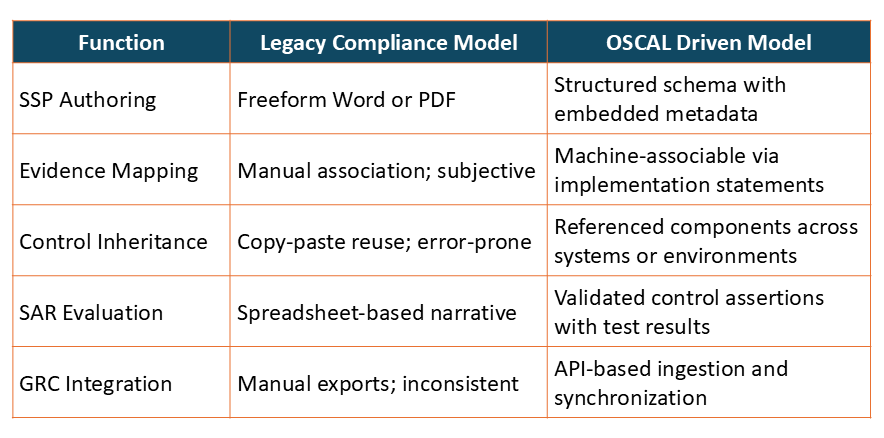
The technical value of OSCAL is clear: it enables automated systems to interpret, validate, and integrate compliance artifacts across heterogeneous environments, eliminating the need for manual formatting, subjective interpretation, and repetitive control rewriting.
Before and After OSCAL: What Changes Technically?
Data Standardization as Strategy
OSCAL represents a fundamental shift in how cybersecurity compliance is approached—moving from static documentation to machine-readable, structured data.
At its core, OSCAL is not just a format; it is a framework for automation, validation, and scalability. By expressing security artifacts, such as System Security Plans (SSPs), Security Assessment Reports (SARs), and Plans of Action and Milestones (POA&Ms), in standardized formats, OSCAL enables consistent interpretation, seamless integration, and faster processing across tools, teams, and systems.
Operationalizing OSCAL means adopting a data-first mindset—where compliance is not a manual output but a continuously validated state. This shift enables agencies and organizations to enhance audit readiness, minimize human error, and expedite the authorization process.
Operationalizing OSCAL Across the RMF Lifecycle
To help federal agencies practically implement OSCAL, forward-leaning compliance programs are embracing full-lifecycle automation strategies that align with evolving cybersecurity mandates and digital transformation goals.
Key technical enablers include:
Schema-Validated OSCAL Artifact Conversion
Transforms legacy System Security Plans (SSPs), Security Assessment Plans (SAPs), and Security Assessment Reports (SARs) into OSCAL-compliant formats while preserving control mappings and implementation metadata. This ensures continuity and consistency across traditional and machine-readable documentation.
Cross-Framework Harmonization
Enables alignment across frameworks such as FedRAMP, NIST 800-53, CMMC, and agency-specific overlays using OSCAL control profiles, tailoring capabilities, and inheritance mappings. This simplifies multi-standard compliance while supporting reuse and reciprocity.
AI-Enabled Evidence Ingestion
Integrates real-time inputs from vulnerability scanners, ticketing systems, and system logs. Natural Language Processing (NLP) models automatically map evidence artifacts to corresponding control identifiers, reducing manual effort and increasing traceability.
Automated SAR and POA&M Generation
Uses test assertions and validation logic to assess control effectiveness and generate machine-readable SARs. Open risks and remediation plans are automatically tracked via dynamically generated Plans of Action and Milestones (POA&Ms), improving oversight and continuous monitoring.
Extensible APIs and Integration Hooks
Supports seamless integration with existing DevSecOps pipelines, security tools, GRC platforms, and incident response systems. This ensures compliance becomes a continuous, embedded process—not a disconnected, episodic activity.

SaaS Security Posture Management (SSPM) + OSCAL = Real-Time Assurance
With the proliferation of SaaS in federal environments, SaaS Security Posture Management (SSPM) has become a critical component of modern risk governance. SSPM tools monitor configuration drift, access policies, encryption settings, and compliance violations across applications like Microsoft 365, Salesforce, and ServiceNow.
But their output is often siloed and disconnected from RMF workflows. By integrating SSPM telemetry with OSCAL artifacts, we enable:
- Real-time mapping of SSPM alerts to RMF controls
- Evidence ingestion into SARs using validated control assertions
- Dynamic POA&M generation when SSPM detects a misconfiguration
- SaaS-specific OSCAL profiles that reduce redundancy in ATO packages
This fusion creates an architecture where SaaS posture data feeds directly into structured compliance reporting, reducing ATO maintenance time and improving control visibility.
The Future: AI-Augmented Compliance Pipelines
As OSCAL adoption grows, its potential goes beyond static reporting. It becomes the foundation for:
- Policy-as-code enforcement using OSCAL profiles as executable control rules
- Continuous ATO (cATO) through integrated SAR/SAP validation against live telemetry
- Predictive compliance drift detection using AI trained on OSCAL-linked artifacts
- LLM-assisted control authoring and assessment planning

ASSYST ComplySyncATO’s roadmap reflects this direction—leveraging AI to reduce workload, flag non-conformance, promote data standardization, and foster interoperability, all while keeping compliance synchronized. Comply.Sync.Now.

ASSYST has expanded its Homeland & National Security Practice with integrated capabilities designed to meet the complex and evolving needs of federal agencies responsible for national resilience, cybersecurity, border protection, and emergency response. This strategic growth supports key priorities for the US Department of Homeland Security (DHS) and its mission partners.
"As agencies prepare for an increasingly dynamic threat environment, there's a growing demand for secure, modular, and compliant technology that adapts to new mandates and integrates easily into mission systems. As a former law enforcement officer, I want to help agencies not just procure this technology, but fully utilize it to assist the boots on the ground," said Eugene Goldlust, Senior Account Executive at ASSYST.

We’ve spent decades supporting federal agencies as they work to improve the delivery of public services. We’ve learned that for military families, veterans, and the people who support them, technology should do one thing above all: make it easier to get the help they need.
That might mean finding the right information quickly, completing a process without frustration, or accessing support while balancing the many realities of military life. Behind every request is a person—often a spouse, a parent, or someone in transition—looking for stability and clarity.
We believe it’s time to make that experience better. Not by adding more systems or interfaces—but by making what already exists more connected, more dependable, and more thoughtful.
The Real Need
Military families move often. They navigate complex benefits, changing school systems, healthcare decisions, and job transitions. Veterans and caregivers face unique challenges. The programs that support them—from readiness and resilience to education and outreach—operate across various systems, policies, and timelines.
Technology can either help or hinder.
Our vision is to help agencies deliver digital tools and services that:
- Reduce duplication and confusion
- Respect the user’s time and circumstances
- Support staff with the right data and context
- Stay reliable during key life moments—deployment, relocation, transition
This isn't about innovation for its own sake. It’s about building systems that do their job, consistently and securely.
How We Support That Vision
ASSYST collaborates closely with federal agencies to modernize systems, enhance security, and improve service delivery. For programs focused on military communities, we focus on four priorities:
1. Design for Real Life
We take a human-centered approach—utilizing our knowledge of military family life to design experiences that are clear, inclusive, and accessible. That includes global integrated services design, mobile-first design, and interfaces that reduce cognitive burden rather than add to it.
2. Keep Data Protected, Always
We build and operate systems with a security-first mindset. From access controls to monitoring and compliance with federal frameworks, our goal is to help programs protect personal information while still allowing users to move forward with confidence.
3. Make Information Work Harder
As the First Place Winner of the GSA Federal AI Hackathon, we are continually seeking ways to make AI More Human-Friendly. We utilize AI and automation thoughtfully, focusing on helping people find answers, complete tasks, or receive guidance. Our Green Accelerator Platform supports workflows that surface useful insights and reduce manual processing, all while maintaining human oversight.
4. Support Program Agility
Policy and program requirements change. Our teams develop modular systems that can be updated without disruption, giving agencies flexibility without high rework or long lead times.
5. Bringing People and Programs Closer Together
We understand that successful service delivery doesn’t just support individuals—it strengthens the relationship between programs and the communities they serve.
We aim to close the gap between:
- Military families and the services built for them
- Program managers and the tools they rely on
- Providers and the systems they access
- CIOs and CISOs who must balance progress with protection
By enhancing the everyday experience of using and managing public systems, we enable agency teams to stay focused on their mission, rather than the technology.
We recognize that the responsibility of supporting military families extends beyond any single system. It requires listening, adjusting, and staying accountable.
ASSYST is ready to be a steady partner in that effort by building services that work, platforms that last, and relationships that reflect a shared commitment to the public good.
