

Type:
From Manual Compliance to Machine Readable Trust with OSCAL
With over a decade of experience in cybersecurity program management, I've gained deep insights into effective and ineffective strategies. My oversight of cybersecurity programs for healthcare government agencies, such as CMS, provides me with opportunities to identify and implement innovative technologies and processes for problem-solving.
A notable challenge, for example, arises when files are received in OSCAL for GRC but cannot be seamlessly transmitted to disparate systems. This gap presents ASSYST with an opportunity to develop a proof of concept for standardizing security artifacts in machine-readable formats, including XML, JSON, and YAML. Ultimately, embracing OSCAL is pivotal for transforming compliance from a hindrance into a strategic advantage.
OSCAL: A Schema for Cybersecurity Consistency and Automation
Developed by NIST, this introduces a structured, machine-readable format (JSON, XML, YAML) for expressing security and privacy control documentation. It applies across the entire Risk Management Framework (RMF), including:
- System Security Plans (SSPs)
- Security Assessment Plans (SAPs)
- Assessment Results (SARs)
- POA&Ms
- Control Catalogs and Implementation Profiles
- Component and Service Definitions
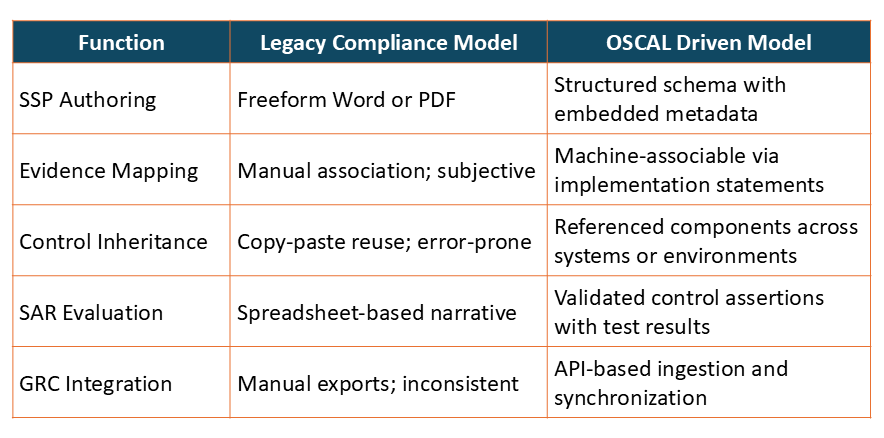
The technical value of OSCAL is clear: it enables automated systems to interpret, validate, and integrate compliance artifacts across heterogeneous environments, eliminating the need for manual formatting, subjective interpretation, and repetitive control rewriting.
Before and After OSCAL: What Changes Technically?
Data Standardization as Strategy
OSCAL represents a fundamental shift in how cybersecurity compliance is approached—moving from static documentation to machine-readable, structured data.
At its core, OSCAL is not just a format; it is a framework for automation, validation, and scalability. By expressing security artifacts, such as System Security Plans (SSPs), Security Assessment Reports (SARs), and Plans of Action and Milestones (POA&Ms), in standardized formats, OSCAL enables consistent interpretation, seamless integration, and faster processing across tools, teams, and systems.
Operationalizing OSCAL means adopting a data-first mindset—where compliance is not a manual output but a continuously validated state. This shift enables agencies and organizations to enhance audit readiness, minimize human error, and expedite the authorization process.
Operationalizing OSCAL Across the RMF Lifecycle
To help federal agencies practically implement OSCAL, forward-leaning compliance programs are embracing full-lifecycle automation strategies that align with evolving cybersecurity mandates and digital transformation goals.
Key technical enablers include:
Schema-Validated OSCAL Artifact Conversion
Transforms legacy System Security Plans (SSPs), Security Assessment Plans (SAPs), and Security Assessment Reports (SARs) into OSCAL-compliant formats while preserving control mappings and implementation metadata. This ensures continuity and consistency across traditional and machine-readable documentation.
Cross-Framework Harmonization
Enables alignment across frameworks such as FedRAMP, NIST 800-53, CMMC, and agency-specific overlays using OSCAL control profiles, tailoring capabilities, and inheritance mappings. This simplifies multi-standard compliance while supporting reuse and reciprocity.
AI-Enabled Evidence Ingestion
Integrates real-time inputs from vulnerability scanners, ticketing systems, and system logs. Natural Language Processing (NLP) models automatically map evidence artifacts to corresponding control identifiers, reducing manual effort and increasing traceability.
Automated SAR and POA&M Generation
Uses test assertions and validation logic to assess control effectiveness and generate machine-readable SARs. Open risks and remediation plans are automatically tracked via dynamically generated Plans of Action and Milestones (POA&Ms), improving oversight and continuous monitoring.
Extensible APIs and Integration Hooks
Supports seamless integration with existing DevSecOps pipelines, security tools, GRC platforms, and incident response systems. This ensures compliance becomes a continuous, embedded process—not a disconnected, episodic activity.

SaaS Security Posture Management (SSPM) + OSCAL = Real-Time Assurance
With the proliferation of SaaS in federal environments, SaaS Security Posture Management (SSPM) has become a critical component of modern risk governance. SSPM tools monitor configuration drift, access policies, encryption settings, and compliance violations across applications like Microsoft 365, Salesforce, and ServiceNow.
But their output is often siloed and disconnected from RMF workflows. By integrating SSPM telemetry with OSCAL artifacts, we enable:
- Real-time mapping of SSPM alerts to RMF controls
- Evidence ingestion into SARs using validated control assertions
- Dynamic POA&M generation when SSPM detects a misconfiguration
- SaaS-specific OSCAL profiles that reduce redundancy in ATO packages
This fusion creates an architecture where SaaS posture data feeds directly into structured compliance reporting, reducing ATO maintenance time and improving control visibility.
The Future: AI-Augmented Compliance Pipelines
As OSCAL adoption grows, its potential goes beyond static reporting. It becomes the foundation for:
- Policy-as-code enforcement using OSCAL profiles as executable control rules
- Continuous ATO (cATO) through integrated SAR/SAP validation against live telemetry
- Predictive compliance drift detection using AI trained on OSCAL-linked artifacts
- LLM-assisted control authoring and assessment planning

ASSYST ComplySyncATO’s roadmap reflects this direction—leveraging AI to reduce workload, flag non-conformance, promote data standardization, and foster interoperability, all while keeping compliance synchronized. Comply.Sync.Now.
