

Type:
Model Context Protocol Fuels AI Agentic Engagement for Enterprise Cybersecurity Data Access

Overview
The Health and Human Services (HHS) agency manages billions of dollars in health insurance programs, generating extensive security-related data crucial for its internal operations. To improve data accessibility within the Security Data Lake ecosystem, ASSYST introduced an advanced chatbot powered by a Large Language Model (LLM) using Generative AI. This chatbot serves key internal stakeholders, including CISOs, SOC teams, Application Development Teams, DevSecOps, and Compliance Teams, by providing precise and immediate access to metadata and security data descriptions. This enhancement supports smarter, faster decision-making and opens new avenues for analytics and AI use cases. Let's delve into the Strategic Transformation in Data Accessibility and Management.
Challenges
The agency required assistance in managing and accessing large volumes of security-related data. Internal teams needed an intuitive and efficient solution to quickly retrieve relevant information without requiring extensive technical expertise. Simplifying data retrieval while enhancing security and compliance operations was crucial. Moreover, the need to support advanced analytics and AI-driven insights added another layer of complexity.
Solution
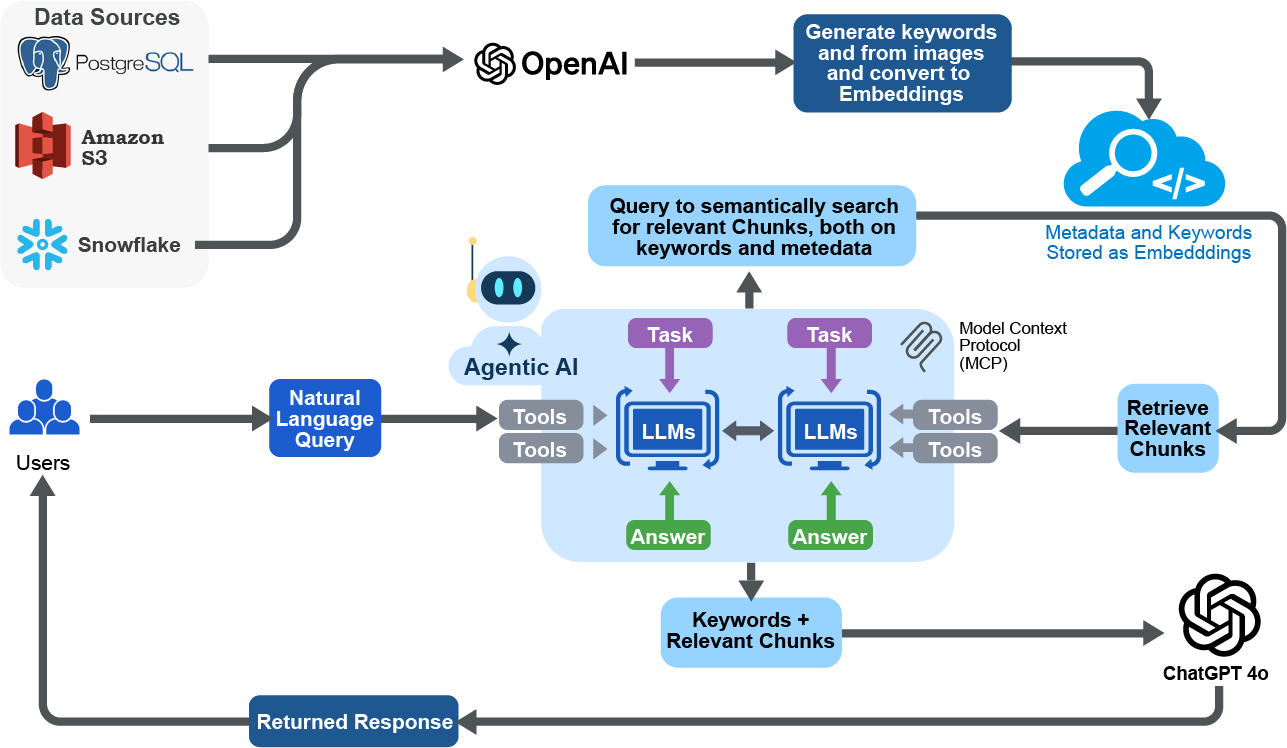
ASSYST has developed a sophisticated LLM-powered chatbot uniquely tailored to the specific needs of internal teams. This chatbot stands out because it can access metadata from the primary documentation database within Snowflake and locate appropriate public views under the public schema, which can be queried using SQL. Users interact with the chatbot to query data directly from the backend, with the system ensuring that sensitive security measures are preserved. The chatbot efficiently retrieves relevant metadata and descriptions from the data catalog, providing users with the information they need while maintaining the integrity and security of the data.
Solution Architecture
To push the boundaries of contextual reasoning, ASSYST’s use of Agentic AI and the Model Context Protocol (MCP) allows the AI to intelligently retain, manage, and apply relevant context over time. This means the chatbot not only responds accurately in the moment but also improves its understanding of user needs with each interaction. By reducing unnecessary processing and surfacing only what’s most relevant, the chatbot delivers faster, smarter, and more contextual responses, empowering teams to make better informed decisions.
The deployment strategy involves hosting the LLM on an EC2 instance, with an API facilitating access to the documentation database table or view. Scheduled data runs on Snowflake store information locally on the EC2 instance, reducing network requests. The front end features a Chatbot-style interface built with ReactJS, accessible on the intranet workspace and via a dedicated webpage. It leverages Nginx and Kubernetes for robust performance.
Users interact with the chatbot interface, which is designed to be intuitive and user-friendly, to request and receive information about the data. The chatbot clarifies data location and relevance, while the LLM performs sophisticated query operations, parsing and interpreting structured metadata from Snowflake's database. Advanced in-memory data processing techniques ensure contextually accurate and detailed responses. The solution supports future enhancements, including advanced NLP and integration with AI-driven tools for enhanced data insights.
Metrics and Outcomes
The chatbot has significantly empowered our internal teams, allowing them to quickly locate and interpret complex security data with minimal specialized skills. It has accelerated response times, enabling SOC and DevSecOps teams to make faster, informed decisions through natural language queries. High adoption rates across security, compliance, and development teams reflect the chatbot’s effectiveness. Streamlined workflows and reduced navigation time through complex data systems have led to considerable gains in operational efficiency.
Realized Benefits
ASSYST’s AI-powered chatbot has transformed data accessibility within the HHS agency’s Security Data Lake. By addressing the specific needs of internal teams and leveraging advanced AI technology, the chatbot enhances decision-making and boosts operational performance while maintaining robust security protocols. This enhancement instills confidence in the user experience. It paves the way for advancements in advanced analytics, AI-driven insights, and future innovations, ensuring continued success in managing and utilizing critical security data.

ASSYST AI Services
The ASSYST AI Center of Excellence (CoE) partners with customers and their internal business and technology teams to embed AI expertise, enhancing agility and growth as AI matures. The CoE provides AI resources, training, and best practices, embedding data scientists, machine learning experts, and product managers into project teams to work closely with domain experts. Clear communication channels ensure ongoing collaboration and knowledge sharing. The CoE evaluates Agentic AI use cases, prioritizing them based on impact, feasibility, and strategic alignment. These use cases may include automating repetitive tasks, enhancing customer experiences, improving communication strategies by identifying user behavior patterns, and detecting fraud or anomalies in financial transactions. For instance, AI can be used to automate the identification and flagging of potential security threats, thereby enhancing the efficiency of Security Operations Center (SOC) teams.
We leverage the ASSYST Green Accelerator Program and solutions like Collab AI and ComplySyncAI to deliver accelerators that support these use cases. We focus on data collection, preprocessing, and ensuring data quality and privacy. Model development leverages algorithms such as decision trees, support vector machines, and neural networks with precise training, validation, and performance assessment. By incorporating and committing to human-centered design principles, we deliver intuitive, user-friendly, responsible, and humane AI solutions that meet end-users' needs.
Let’s discuss your AI Use Case.